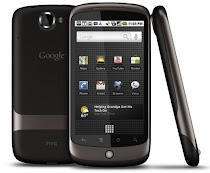
Google Nexus One Feature Overview & Full Technical Specifications

Google Nexus One Android Smartphone

The Google Nexus One is Google's new Android Smartphone that uses the Android Mobile Technology Platform 2.1 (Eclair), an open source mobile operating system. Google Nexus One devices is manufactured by Taiwan based Smartphones Manufacturer, HTC Corporation, and became available since January 5, 2010. Features of the phone include the ability to transcribe voice to text, noise canceling dual microphones, and GPS guided turn-by-turn voice directions to drivers.

The Google Nexus One mobile device is sold unlocked (not restricted to use on a single network provider). Google currently offers it for use on the T-Mobile and AT&T networks in the United States; a version for use on Vodafone (European) networks was announced on 26 April 2010, available in the UK on 30 April 2010. On March 16, 2010, the Nexus One device became available on the Google web store for sale in Canada for use with Rogers Wireless, Telus, Bell and Wind Mobile. The phone will also be available with Sprint-Nextel as announced on March 17, 2010. There is no release date or price details for the Nexus One on Sprint.

Google Nexus One Full Specifications

Dimensions :

Height : 119mm

Width : 59.8mm

Depth : 11.5mm

Weight : 100g without battery and 130g with battery

Processor :

Qualcomm QSD 8250 1 GHz (Snapdragon)

Display :

800 x 480 pixels 3.7 inch (diagonal) widescreen WVGA AMOLED touchscreen with 100,000:1 typical contrast ratio and 1 ms typical response rate

Capacity :

Ram : 512 MB

Flash : 512 MB

Micro SD Card : 4GB expandable to 32 GB

Battery Life :

Removable 1400 mAH battery

Talk Time on 2G networks : Up to 10 hours

Talk Time on 3G networks : Up to 7 hours

Standby Time on 2G networks : Up to 290 hours

Standby Time on 3G networks : Up to 250 hours

Internet use on 3G networks : Up to 5 hours

Internet use on Wi-Fi : Up to 6.5 hours

Video playback : Up to 7 hours

Audio playback : Up to 20 hours

Camera Images and Videos :

5 Megapixel camera with autofocus from 6 cm to infinity,LED Flash and 2X digital zoom. User can include location of photos from phone’s AGPS receiver

Support JPEG (encode and decode) GIF PNG BMP formats

Video captured at 720x480 pixels at 20 frames/sec or Google-Nexus-One-specs higher and depending on lighting conditions

Cellular and Wireless :

UMTS Band 1/4/8 2100/AWS/900

HSDPA 7.2 Mbps

HSUPA 2 Mbps

GSM/EDGE 850,900,1800,1900 MHz

Wi-Fi 802.12b/g

Bluetooth 2.1 + EDR

A2DP stero Bluetooth

Buttons and Controls :

Power key

Volume up/down key

Tricolor clickable trackball

4 illuminated softkeys : Back,Menu,Home,Search

Teflon coated back cover

Connectors :

3.5 mm 4 connector stereo headset jack

Tricolor charging and notification indicator

Speaker

Microphone

Micro USB port

Dock pins

Additional Features :

Light Sensor

Proxinmity Sensor

Sim card and Micro SD card slot

Haptic feedback

Second microphone for active noise cancellation

Multitasking

Voice commands

Wi-fi

GPS Turn by Turn and digotal compass

Application store :

Android Market with 16,000 applications

Google Buys Stealth Hardware Startup Agnilux

Google Buys Stealth Hardware Startup Agnilux

It's not a secret anymore that Google, the world's number one Internet Search Engine, currently has been fond of doing acquisitions of other companies. Especially for small companies that are considered by Google as has good performance but are constrained by capital to expand their businesses.

However, one of Google's latest acquisition is raising some big questions for many parties. Google has acquired Agnilux Inc, a stealth startup based in San Jose, California.

It's quite interesting for the observers of the internet technology. Because, Agnilux is a company consisting of former employees of Apple Inc. and PA Semi (Palo Alto Semiconductor), a Santa Clara, California based PowerPC processor company.

A few years ago, Apple bought PA Semi, whose technology, some claim, ended up in Apple's A4 processor. Some PA Semi people, however, left Apple shortly after the acquisition, opting to found a new start-up company instead. In addition, Scott Redman, Agnilux's director of application software is a former of software architect at TiVo.

Although Agnilux has never been officially announced what projects they are working on, the New York Times has reported that the company is in collaboration with Cisco of making the technology "Some kind of server" - that's as far as The New York Times got.

Mark Hayter, the chief operating officer at Agnilux, told The New York Times, "We want to make a splash, We don't want our manufacturer to take our intellectual property before we're ready." In other words, we have no clue as to what these guys are building.

Some industry speculation has Google’s interest in Agnilux stemming from a desire to wring more efficiency from its power-hungry data centers; others have mused that Google might be looking to expand its hardware business. Google already offers the Google Search Appliance and Google Mini to companies who want to deploy in-house Google search capabilities.

Google Removes http:// From Google Chrome Browser's Address Bar

Internet users often write 'http://' followed by the address of a site in the address bar or URL box. HTTP, an abbreviation for Hypertext Transfer Protocol (A protocol used to request and transmit files, especially webpages and webpage components, over the Internet or other computer network), is felt as no longer needed because browser like Chrome has made the 'http://' as a default in the URL box, so that http:// is no need to be included again.

URL (Uniform resource locator or universal resource locator; an addressing scheme used by World Wide Web browsers to locate resources on the Internet) is a series of characters according to a certain standard formats, used to indicate the address of a source such as documents and images on the Internet.

Later on, URL fields will no longer display the 'http://', so Google Chrome users would no longer see http:// and simply enter the site address directly. Besides the problem of space in the URL box, the inclusion of http:// also often considered as a problem.

As reported by Mashable, Monday (19/4/2010), this step directly get some comments from many readers on the Chromium wiki forum. "A lot of blogs, email and instant messaging software is quite dependent on the matching of http:// to auto-link URLs. Eliminates http:// will train users to slowly remove it, where it will have a negative impact on access to all sites," wrote one visitor in Chromium Wiki forum.

Google itself claims to have added the scheme to the user's clipboard when the user doing a copy-paste of the URL from the URL field. However, Google did not explain about the other protocol schemes like ftp, https, and gopher.

Not only Google Chrome, but Apple's browser, Safari will also hide the http:// feature in its browser.

Google Profits & Revenue Rise 23% In The First Quarter Of 2010

Google Revenue Profits

Internet giant, Google, records its revenue and profit growth in first quarter of 2010 has reached U.S. $ 6.77 billion in the period ended March 31 2010, increased of 23 percent compared to the same period last year.

In addition, Google gets a net income of U.S. $ 1.96 billion or U.S. $ 6.06 per share. The New York Times reported that last year, they was received U.S. $ 1.42 billion or U.S. $ 4.49 per share. Based on pro forma, Google's net income that exclude a number of items reached U.S. $ 2.18 billion or U.S. $ 6.76 per share. In the first quarter of 2009, Google got U.S. $ 1.64 billion or U.S. $ 5.16 per share.

On March 31, 2010, Google had cash, short-term securities, and cash equivalent of U.S. $ 26.5 billion. The number of employees increased from 19,835 people to 20,621 employees.

Throughout the first quarter of 2010, Google is never free from controversy. In January, Google was surprised the world by claiming to stop censoring their search results in China. A month later, Google launched the Buzz that was criticized due to violation of privacy rules.

Google actually stop censorship in China in March and move the operations of Google.cn services to Hong Kong. They was claimed forced to take this step because it could not deal with hackers to attack their systems and to a number of Gmail accounts owned by China's human rights fighters. Meanwhile, Google also has improved the privacy rules of its social networking service, Buzz.

Approximately 66 percent of all Google's revenue comes from its own site pages while their peers contributing 30 percent. As many as 53 percent of revenue comes from outside the United States (U.S.).

Google Caffeine: Google's Newest Secret Project

Google Caffeine

Google plans to improve its search engine performance using caffeine, but not caffeine in its actual meaning. Caffeine is a secret code to the project of technology development by Google's newest search engine developer. Google also name it as the next-generation architecture for Google's web search.

Sitaram Iyer, Staff Software Engineer and Matt Cutts, Principal Engineer in the Official Google Webmaster Central Blog wrote, "For the last several months, a large team of Googlers has been working on a secret project: a next-generation architecture for Google's web search. It's the first step in a process that will let us push the envelope on size, indexing speed, accuracy, comprehensiveness and other dimensions."

Main target of Caffeine development is to create a search that can produces faster results, accurate, and based on the context. The more relevant search results and faster time of searching as Twitter and Bing done may be one of the main concerns that also configured.

Infrastructure for the newest technology is under one roof with a search engine that is currently used. Therefore, most users will not feel any changes of the search results. However, web developers and internet users who rely on Google search results in their business will feel the changes.

Therefore, Google is opening opportunities to all internet users, especially software developers to provide feedback to the project. Although stepping its early stage, the search results with caffeine technology can tested in www2.sandbox.google.com.

When trying it, and you think that you need to send some advices or feedback do not forget to click the "Dissastified? Help us improve" link at the bottom of the page and do not forget to include the word "caffeine" in your comments to distinguish the entries against a regular Google search engine.

[For Further Info, visit Google Webmaster Central Blog.

Moon in Google Earth: Virtual Exploration of The Moon Surface

Google Earth / Moon

Monday July 20 2009 is the 40th commemoration day for the first men landing on the moon surface by Apollo 11 mission. Google has chosen to mark the event by releases a set of maps for Google Earth that allows you to browse on the surface of the moon. Google updated its most popular mapping software Google Earth 5.0 with a complete map of the moon that lets you explore craters, historic sites, and human artifacts. You can even view the moon in the style of Google Street View, checking out astronauts as they wander the moon's surface.

Google Earth is free software. So, you need only get the latest version to explore moon surfaces. If you don't have it already, you need to immediately download Google Earth 5.0. When it's be done then you are right to do the necessary upgrades.

To access the latest map of moon, look for the icon with the ringed planet on the Google Earth toolbar, and select "Moon" from the drop-down list. You will immediately recognize if there are also menu options for Mars and Sky.

Google Moon in Google Earth

Those options are the developments from the earlier Google Earth. Google Maps users, sometimes, may also have been exploring the moon, the night sky, and Mars, in a web browser. Some amazing metadatas present with a moon map of Google Earth, making feasible to be downloaded.

There are interactive tours to views different moon surfaces with narrative accompaniment from the Apollo astronauts, Buzz Aldrin and Jack Schmitt. Google Earth also includes montage of 360 degrees images from the moon landing-sites, the clip was edited from various Apollo missions and a map of the training used by the Apollo astronauts.

Apollo Mission On Google Moon

Not lag from the Exploration, 3-dimensional model of the land on the moon surface, complete with the Space Shuttle, Exploration vehicles and the artefacts left by some people in the only Earth's satellite.


Apple iPhone 4Gs Logo
Apple iPhone 4G Launch June 22
When Apple Inc. launches its iPhone 4G? This question is so prominent recently. The loyal users of Apple products are very curious on rumours says that Apple iPhone 4G/HD will soon be launched.
Google Chrome Browser
Google Hides HTTP In Chrome
Chrome's URL box will no longer display the http://, so users could types the site address directly without started with http://. Besides the problem of space, the inclusion of http:// often considered as a problem.
facebook Logo
Facebook Unveils Its Safety Center
In order to combat the "cyber predators" activities that targeting children and young girls as their victims, Facebook recently has unveiled the Facebook Safety Center.
Opera
Opera Acquires FastMail
In its press release recently, Opera said that the acquisition will enable Opera to expand its current messaging product portfolio and deliver cross-platform messaging to a wide range of devices, including computers, mobile phones, TVs and gaming consoles.


HP Compaq Laptop
HP Compaq Airlife 100
Compaq AirLife 100 launches with an excellent specifications that features Bluetooth EDR, 802.11b/g WiFi, dual-band HSDPA 3G and dual-band GSM/GPRS/Edge connectivity.
Apple MacBook Pro
MacBook Pro MC375LL/A
Apple Inc says MacBook Pro MC375LL/A could work longer away without to worry about the battery will be runs out, because it has an automatic graphics switching.
Dell Laptop
Dell Latitude E6410 ATG
Dell Inc., one of the world's top supplier of Desktop and Notebook PC announces that the Latitude E-Family with Intel Core i5 and Core i7 processors has already launched.